From Waste to Circularity: New EU Rules Are Reshaping the Future of Textiles
What happens to a piece of clothing that is produced but never sold? Until recently, the answer could simply be: it is destroyed. Across Europe, an estimated 4–9% of unsold textiles are destroyed before ever being worn, generating unnecessary environmental impacts and wasting the raw materials, water, energy and labour used to produce them.
What happens to a piece of clothing that is produced but never sold?
Until recently, the answer could simply be: it is destroyed. Across Europe, an estimated 4–9% of unsold textiles are destroyed before ever being worn, generating unnecessary environmental impacts and wasting the raw materials, water, energy and labour used to produce them.
The European Union is now taking another important step towards changing this model.
Since 19 July 2026, large companies operating in the EU are prohibited from destroying unsold apparel, clothing accessories and footwear under the Ecodesign for Sustainable Products Regulation (ESPR). Medium-sized companies will become subject to the same prohibition from 2030.
But the significance of the new rules goes beyond what happens to clothes left on store shelves. They are part of a much broader transformation of the textile and fashion sector: from a largely linear model of produce, consume and discard towards one in which products, materials, skills and information remain valuable for longer.
What changes under the new EU rules?
The new requirements establish a clear priority: unsold products should remain in use whenever possible.
Instead of destroying them, companies are expected to explore alternatives such as selling them through discounts or alternative markets, donating them to charities or social enterprises, or preparing them for reuse through repair, refurbishment or remanufacturing.
Destruction remains possible only under specific circumstances—for example, when products are unsafe or damaged, counterfeit, infringe intellectual property rights, or cannot be accepted through donation schemes. Companies using these exemptions must be able to provide evidence and keep appropriate records.
The measure also introduces greater accountability. Companies must disclose information concerning discarded unsold consumer products, while national authorities will be responsible for monitoring compliance.
Part of a much bigger transformation
The prohibition should not be viewed in isolation.
Through its EU Strategy for Sustainable and Circular Textiles, Europe has set out a vision in which textile products placed on the EU market are increasingly durable, repairable and recyclable, contain recycled fibres where possible, and are produced with greater consideration for environmental and social impacts.
The scale of the challenge explains the ambition. Around 5 million tonnes of clothing are discarded every year in the EU—approximately 12 kg per person—while only around 1% of the material used in clothing is currently recycled into new clothing.
The EU's approach therefore increasingly looks at the whole lifecycle of a textile product.
Among the measures being developed are ecodesign requirements, Extended Producer Responsibility schemes, support for reuse and repair, restrictions concerning textile waste exports and the introduction of Digital Product Passports (DPPs). Textile apparel has already been identified as a priority product group for future ecodesign and DPP requirements.
A Digital Product Passport could eventually make relevant information about a textile product more accessible throughout its lifecycle, supporting greater transparency and facilitating circular practices such as repair, reuse and recycling.
Taken together, these developments point towards an important change in thinking: the most sustainable textile waste may ultimately be the waste that was never created.
The textile transition is not limited to Europe
Europe is moving quickly, but the transition towards more circular textiles is becoming an international challenge.
In the United States, California is implementing the Responsible Textile Recovery Act, the first state-level Extended Producer Responsibility programme of its kind for textiles. The legislation makes producers responsible for developing systems that enable covered textile products to be collected, repaired, reused and recycled. Producers of covered products were required to join the approved producer responsibility organisation by July 2026.
Across the Pacific, Japan is also strengthening its approach to circular fashion. Its national circular-economy policy includes a target to reduce clothing discarded by households by 25% by fiscal year 2030 compared with 2020. In March 2026, the Japanese government also published an action plan for sustainable fashion and a roadmap for resource circulation in textile products towards 2030.
Technology is evolving alongside regulation. In China, for example, advanced automated sorting systems using artificial intelligence are being deployed to identify textile fibres and improve the efficiency with which used garments can be separated for recycling.
The regulatory approaches are different, but the direction is increasingly familiar: keeping textile materials in circulation for longer, improving collection and recycling, creating greater producer responsibility and developing technologies capable of supporting a circular textile economy.
Where does 3DP-STeF fit into this transformation?
Regulation can establish new requirements, but transforming an industry also requires something else: people with the skills to implement change.
This is where the 3DP-STeF project becomes particularly relevant.
3DP-STeF focuses on the intersection of 3D printing, sustainable textile and fashion design, and green and digital skills. Through its educational activities, the project aims to equip higher education students, VET learners, educators and industry professionals with knowledge and competencies that can support the transformation of textile and manufacturing practices.
The project is developing a Master's Programme in 3D Printing and Sustainable Textile & Fashion Design, alongside flexible micro-credential modules for industry and VET professionals. These programmes explore how emerging manufacturing technologies and sustainable design approaches can become part of future textile and fashion workflows.
This connection matters because circularity begins long before a garment reaches a recycling facility.
It begins when materials are selected. It continues when products are designed, prototypes are developed and manufacturing decisions are made. Technologies such as additive manufacturing and digitally enabled production can contribute to exploring new approaches to prototyping, customisation, material efficiency and production—while sustainable design principles can help future professionals consider the entire lifecycle of what they create.
The emerging regulatory environment therefore reinforces the importance of combining technological innovation with sustainability skills.
Designing the textile sector of tomorrow
The EU's prohibition on destroying unsold clothing sends a simple but powerful message: producing something only to discard it unused can no longer be considered a normal part of doing business.
But preventing destruction is only one piece of the puzzle.
A truly circular textile economy requires better design, smarter production, new materials and technologies, repair and reuse systems, effective recycling infrastructure, reliable product information—and professionals capable of bringing all these elements together.
Across Europe, California, Japan and other parts of the world, policy and industry are beginning to move in this direction.
For the next generation of textile designers, manufacturers and professionals, sustainability will therefore increasingly be more than an additional consideration. It will become part of how products are conceived, designed, produced and managed throughout their lifecycle.
Through education, experimentation and the combination of digital and green skills, projects such as 3DP-STeF can help prepare professionals not simply to comply with this transition, but to actively shape it.
The future of textiles will not only be about what we make. It will increasingly be about how intelligently we design, produce, use and reuse what we make.
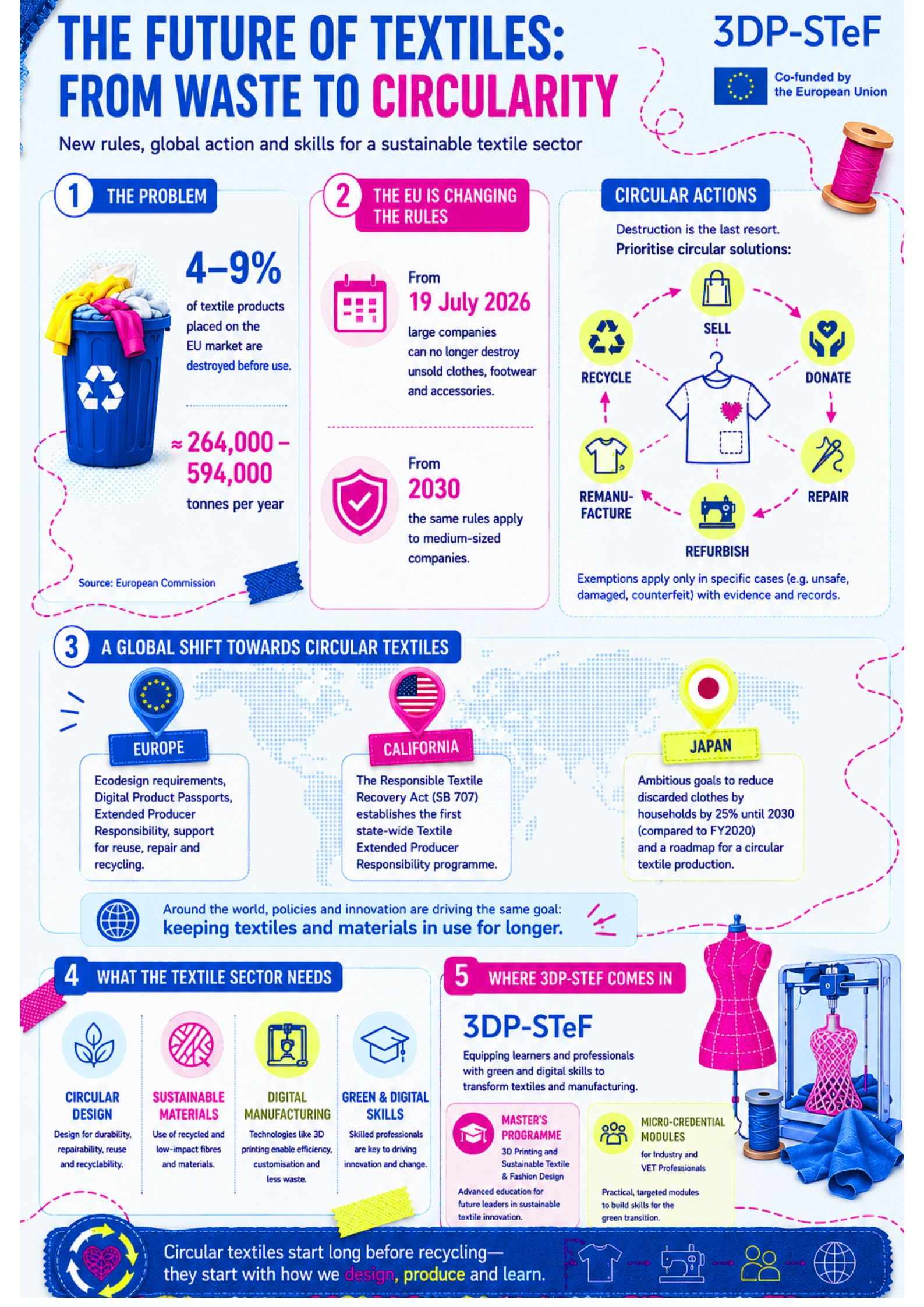
Did you like the infographic? You can also download it from here.
%20(Landscape))%20(2).jpg)